

Artificial intelligence is no longer just a technology trend. It is becoming part of the everyday workflow of real estate professionals.
From creating listing content and analyzing market information to helping buyers research properties, AI is changing how real estate professionals work—and how consumers begin their homebuying journey.
According to a 2026 survey of REALTORS® conducted by Realtors Property Resource (RPR), 92% of respondents are currently using AI or plan to use it, while 71% identified saving time as the biggest benefit. At the same time, 63% said accuracy is their biggest concern. So, what does this mean for real estate professionals?
AI isn’t necessarily replacing the real estate agent. Instead, it is becoming a tool that can help agents work faster, serve clients more efficiently, and focus more time on the parts of the business where human expertise matters most.

1. AI Is Becoming Part of the Everyday Real Estate Workflow
One of the biggest changes in 2026 is that AI is moving beyond simple chatbots. Newer AI systems can help professionals with multi-step workflows, including drafting messages, updating CRM records, scheduling follow-ups, and triggering other tasks. This type of technology, sometimes called agentic AI, is designed to perform actions rather than simply provide answers. For a busy real estate professional, this can mean less time spent on repetitive administrative work and more time available for clients.
Examples of tasks AI can help with:
- Drafting emails and follow-up messages
- Creating social media content
- Organizing information
- Summarizing documents
- Preparing marketing materials
- Creating client FAQs
- Brainstorming listing strategies
- Automating repetitive workflows
The goal isn’t to let AI run the business on its own. The goal is to let technology handle some of the repetitive work while the professional remains in control.
2. AI Is Changing How Buyers Search for Homes
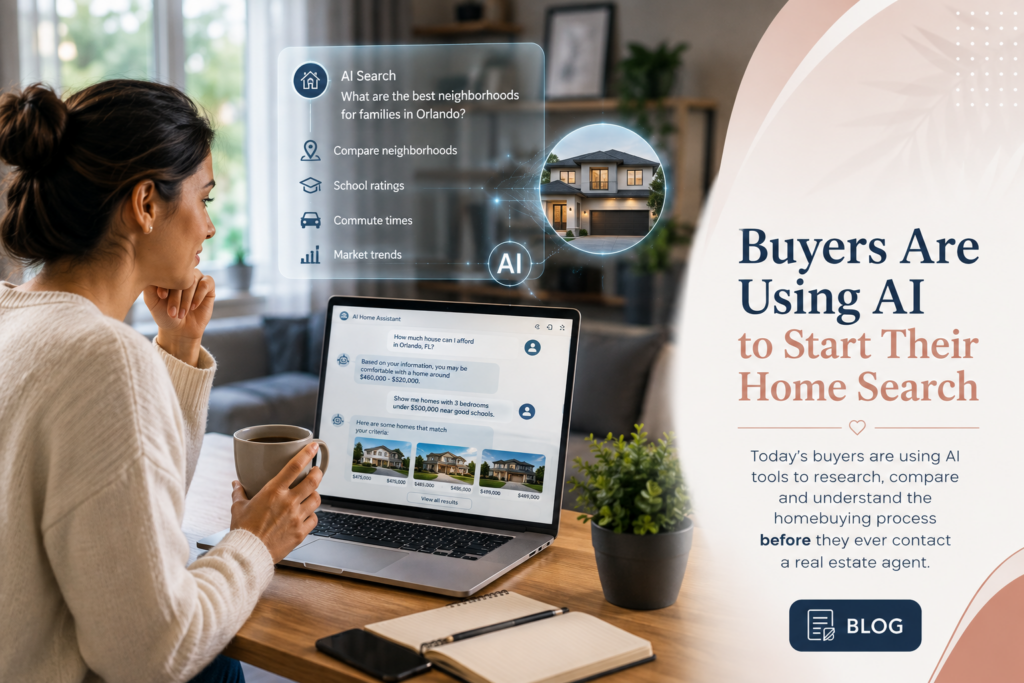
AI isn’t only changing the way agents work. It is also changing the way consumers begin their real estate journey. A 2026 Bank of America Homebuyer Insights survey found that 20% of prospective buyers and current homeowners have used AI tools or chatbots for homebuying research. Among younger consumers, adoption is even higher. Buyers are using AI to answer questions such as:
- How much house can I afford?
- What might my monthly payment look like?
- What should I know before buying a home?
- How does a particular neighborhood compare with another?
- What are current home values?
- What costs should I expect when purchasing a home?
This means that consumers may interact with AI before they ever contact a real estate agent.
For professionals, that creates an important opportunity: make sure your online presence provides accurate, useful and trustworthy information that AI systems can understand and reference.
3. AI Can Help Real Estate Professionals With Marketing
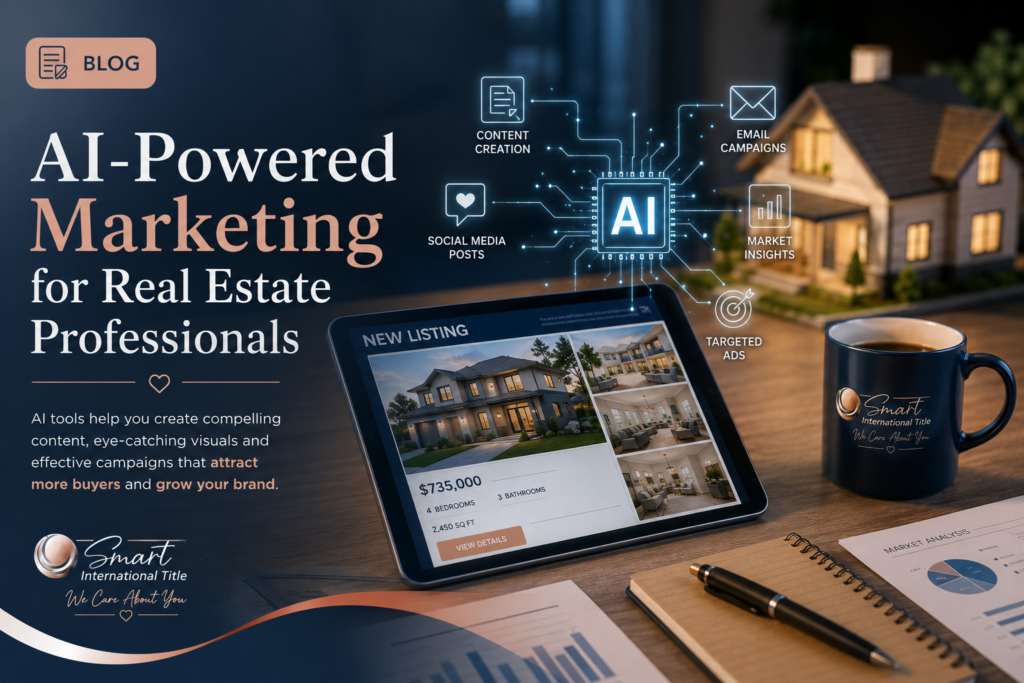
Marketing is one of the areas where AI can save agents a significant amount of time. Instead of starting every piece of content from scratch, professionals can use AI to help create:
- Listing descriptions
- Social media captions
- Email campaigns
- Blog ideas
- Video scripts
- Property highlights
- Open house promotions
- Buyer and seller educational content
AI-powered tools are also being used to improve listing images, remove visual clutter, enhance lighting and create virtual staging. NAR reports that these tools can help agents create more polished listing presentations and reduce production time.
But there is an important rule:
AI-generated marketing should always be reviewed by a human before it is published. An AI tool can produce a beautifully written description that contains a fact that isn’t true about the property. Technology can help you create faster. It doesn’t eliminate your responsibility to verify the information.
4. AI Can Help With Data and Market Analysis
Real estate professionals work with large amounts of information every day. Market statistics, property characteristics, pricing information, neighborhood trends and transaction data can be difficult to process manually. AI-powered tools can help professionals organize and interpret information more efficiently. For example, AI can assist with:
Market research
Identify patterns and summarize large amounts of market information.
Property analysis
Organize property characteristics and comparable information.
Client presentations
Turn complex information into easier-to-understand explanations.
Content creation
Transform market data into newsletters, social media posts, videos or educational articles.
NAR’s 2026 member resources already include AI-powered tools designed to help REALTORS® turn real estate data into articles, presentations, videos and social media content.
The key is to think of AI as an analysis assistant, not as the final authority.
5. AI Is Becoming Part of the Home Search Experience
The traditional online listing is also evolving. Instead of simply looking at photos, price and property details, buyers are beginning to expect more interactive experiences.
AI-powered property search can potentially help consumers ask questions about homes, compare properties, explore neighborhood information and receive personalized recommendations. NAR reports that AI is adding a new layer of personalization to home search, allowing buyers to interact with property information in more conversational ways.
Imagine a buyer saying: “Show me homes under $500,000 with three bedrooms, a large backyard and a short commute to work.”
Instead of manually filtering dozens of listings, AI can help narrow the search based on a combination of preferences. This doesn’t mean the agent becomes unnecessary. In fact, as the amount of information increases, professional guidance can become even more valuable.
6. Real Estate Professionals Need to Think About AI Visibility

There’s another emerging concept that agents should understand:
Generative Engine Optimization (GEO)
You may already be familiar with SEO, or Search Engine Optimization, which helps websites appear in traditional search engines. GEO focuses on making your online presence easier for AI-powered search tools to understand and potentially reference.
Consumers are increasingly asking AI tools questions such as: “Who is the best real estate agent in my area?” or “Who can help me buy a home in Orlando?”
NAR has highlighted GEO as an emerging lead-generation strategy for real estate professionals. That means having a strong digital presence matters more than ever.
Start with the basics:
- Keep your professional profiles complete and accurate.
- Publish useful educational content.
- Create content about your local market.
- Answer common buyer and seller questions.
- Keep your website information updated.
- Maintain consistent business information across platforms.
- Share your expertise rather than simply promoting listings.
The goal is to become a trusted source of information, both for people and for the technology they increasingly use to find information.
7. The Biggest Advantage AI Can't Replace: Human Expertise
With all of these developments, one question naturally comes up:
Will AI replace real estate agents?
The current evidence suggests that the more important question may be:
Which real estate professionals will learn to work effectively with AI?
AI can analyze information quickly. It can generate content, summarize documents and automate repetitive tasks. But real estate involves much more than information. Clients still need professionals who can:
- Understand their individual circumstances
- Explain complicated situations
- Negotiate
- Recognize potential problems
- Provide local knowledge
- Communicate clearly
- Build trust
- Make informed judgments
- Guide clients through stressful decisions
Recent NAR coverage emphasizes that AI can perform much of the “heavy lifting,” but human judgment remains essential.
For many consumers, that human connection remains one of the most valuable parts of the real estate experience.
The Smart Way to Use AI in Real Estate
The best approach isn’t AI vs. humans. It’s AI + human expertise. Use AI for tasks where speed, organization and automation are helpful. Then use your professional experience to review the information, add context and make the final decision.
Before publishing or sharing AI-generated information, ask:
- Is this information accurate?
- Did I verify the facts?
- Does it comply with applicable rules and regulations?
- Does it protect my client’s private information?
- Could the wording be misunderstood?
- Am I relying on AI where professional judgment is required?
AI can make your workflow faster, but you are still responsible for the final result.
Final Thoughts

Artificial intelligence is changing real estate faster than many professionals expected.
Buyers are already using AI to research affordability, neighborhoods and the homebuying process. Agents are using it for marketing, data analysis and administrative tasks. And newer AI systems are beginning to automate more complex workflows.
The opportunity isn’t to replace the human side of real estate. It’s to use technology to make that human side even stronger. The real competitive advantage may belong to the professionals who can combine the efficiency of AI with the trust, experience and personal attention that clients still value.
At Smart International Title, we believe technology should make the real estate experience more efficient, but never less personal.
We Care About You.

This article is intended for general informational purposes only and does not constitute legal, financial, tax, or real estate advice. Short-sale requirements and outcomes vary depending on the circumstances and the parties involved. Consult the appropriate licensed professionals regarding your specific situation.